The Person Behind the Click
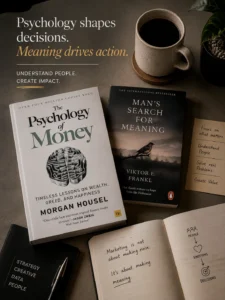
I've been reading two books lately that have nothing to do with marketing on paper. Man's Search for Meaning by Viktor Frankl, and The Psychology of Money by Morgan Housel. One's about how people relate to wealth. The other is about finding purpose through suffering, written by a man who survived Nazi concentration camps. Neither book mentions Meta Ads or CPL a single time.
Still, both kept pulling me back to the same thought about the work I actually do every day.
People don't decide with logic
We like to believe we do. We tell ourselves buying decisions come down to price, features, whatever's on the spec sheet. Most of the time that's not really the problem.
It's harder to pin down what actually drives a decision. Things like:
- Emotions
- Fears
- Goals
- Past experiences
- The meaning someone attaches to whatever they're about to buy
Housel writes about this a lot in Psychology of Money. His point is that financial decisions aren't math problems, they're personal stories people tell themselves about risk and security and what "enough" even means to them. Two people can earn the same pay but make completely different decisions with it, not because one is more brilliant than the other, but because they're living out separate financial stories.
Same product, different reasons to buy
A customer doesn't really care that your product has ten more features than a competitor's. They care what those features actually mean for them.
Take something simple, like a house. A better house could mean:
- Security, if someone grew up without much stability
- Status, if they've spent years comparing themselves to family or friends
- A better shot at life for their kids, if that's what they've been working toward this whole time
Same house. Completely different reasons to want it. If your ad is about "security" and the person scrolling past is actually looking for "status," the targeting can be perfect, but the creative can still fail. You're simply answering a question nobody asked.
What this means for performance marketing
This has quietly changed how I look at the job. It's easy to reduce performance marketing down to a checklist:
- Find the right audience
- Build a creative that works
- Optimize the campaign
- Get the CPA down
Those things matter, I'm not saying otherwise. But there's a layer underneath all of it that's easy to skip when you're staring at a spend graph, and that's actually understanding the person on the other side of the click.
What do they want. What are they scared of. What are they actually trying to get to. Why does this product matter to them specifically, not to "the average customer."
This is close to what Frankl was writing about, in a very different and far heavier context. His argument was that people aren't driven mainly by pleasure or even survival, but by meaning, and he watched that play out in circumstances most of us will never come close to. I'm seeing a much smaller version of the same idea in ad accounts. Campaigns that connect to what someone actually cares about tend to beat campaigns that are just mechanically optimized, even when the mechanics are done well.
Still figuring this out
I'm not writing this like I've solved it. I haven't. I'm still learning how to do this properly, how to read the person behind the numbers and not just the numbers themselves. That's a lot harder to turn into a repeatable process than audience targeting or creative testing ever was. But I think it's the actual difference between a campaign that converts and one that just looks good in a report.
Two books that have nothing to do with marketing taught me more about it than most marketing content I've read all year. I'd take that trade again.